
What Is Piriformis Syndrome?
Piriformis Syndrome is a condition in which the piriformis muscle irritates or compresses the sciatic nerve near the buttock. This irritation may produce pain, tingling, or numbness that travels into the back of the thigh or leg. Symptoms can resemble sciatica caused by a spinal disc or nerve-root problem.
Quick Facts About Piriformis Syndrome
Category
Muscle-related nerve irritation
Used for
Evaluating buttock pain with leg symptoms
Common confusion
Often confused with lumbar sciatica
Also called
Piriformis muscle syndrome
Often discussed with
Sciatica Treatment
Key Takeaways About Piriformis Syndrome
- The irritation occurs near the piriformis muscle and sciatic nerve.
- Leg symptoms can come from the buttock, not only the lower back.
- Piriformis Syndrome is not identical to spine-related sciatica.
How Piriformis Syndrome Works
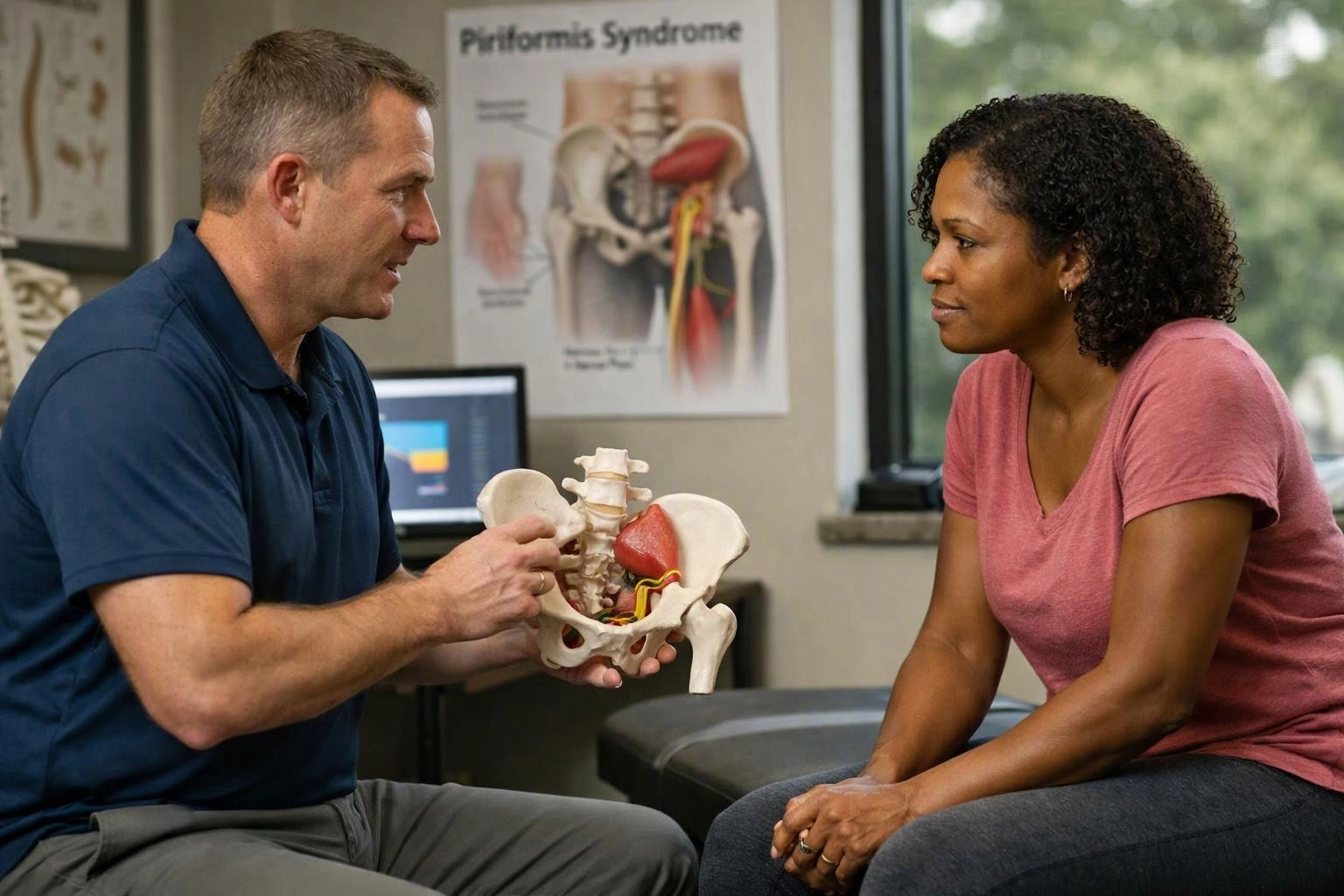
Piriformis Syndrome develops when the piriformis muscle affects the nearby sciatic nerve. The muscle sits deep in the buttock and helps rotate the hip. Irritation in this area can send symptoms along the nerve's path, including the buttock, thigh, or lower leg.
Related glossary terms: Lumbar Spine, Referred Pain, Myofascial Pain.
A clinical assessment separates this pattern from symptoms linked to the lumbar spine or a nerve root. The assessment may consider pain location, hip movement, muscle tenderness, strength, sensation, and walking mechanics. The sciatic nerve can respond to pressure in more than one location, so the source of symptoms guides the working diagnosis and care plan.

From the Arrowhead Clinic Chiropractor Hinesville team
When we assess Piriformis Syndrome, we review the symptom pattern and examine the lower back, pelvis, hip, and affected leg. We also consider movement, tenderness, strength, and sensation to distinguish buttock-level nerve irritation from other causes of sciatica.
Piriformis Syndrome in Practice: A Real-World Example
A person with pain that begins deep in the buttock and travels down the back of the thigh may have Piriformis Syndrome. During Sciatica Treatment, the evaluation considers hip movement and lower-back findings to identify the likely source.
Related Services
Related Terms
Lumbar Spine
Lumbar Spine is the lower section of the spinal column between the thoracic spine and pelvis…
Referred Pain
Referred Pain is a pain signal felt in an area away from its source. The source…
Myofascial Pain
Myofascial Pain is discomfort that arises from irritated or sensitive muscle tissue and the fascia surrounding…
Range of Motion
Range of Motion is the available movement at a joint, measured through a specific direction or…
Arrowhead Clinic Chiropractor Hinesville
Have Questions About Piriformis Syndrome?
Contact Arrowhead Clinic Chiropractor Hinesville for practical guidance on Piriformis Syndrome and related chiropractor work in Hinesville.