
What Is a Rotator Cuff Strain?
Rotator Cuff Strain is an overstretching or irritation injury affecting the muscles or tendons that support shoulder movement. It may develop after repeated overhead activity, sudden force, or poor load control. Common features include shoulder pain, tenderness, weakness, and reduced movement, although symptoms can vary with the affected tissue and activity.
Quick Facts About Rotator Cuff Strain
Category
Soft tissue shoulder injury
Used for
Sports injury assessment and care
Common confusion
Shoulder impingement or tendon tear
Also called
Rotator cuff injury, Shoulder muscle strain
Often discussed with
Sports Injury Treatment, Therapeutic Exercise
Key Takeaways About Rotator Cuff Strain
- It affects shoulder-supporting muscles or tendons.
- Repeated overhead activity can aggravate symptoms.
- A strain is not the same as shoulder impingement.
How Rotator Cuff Strain Works
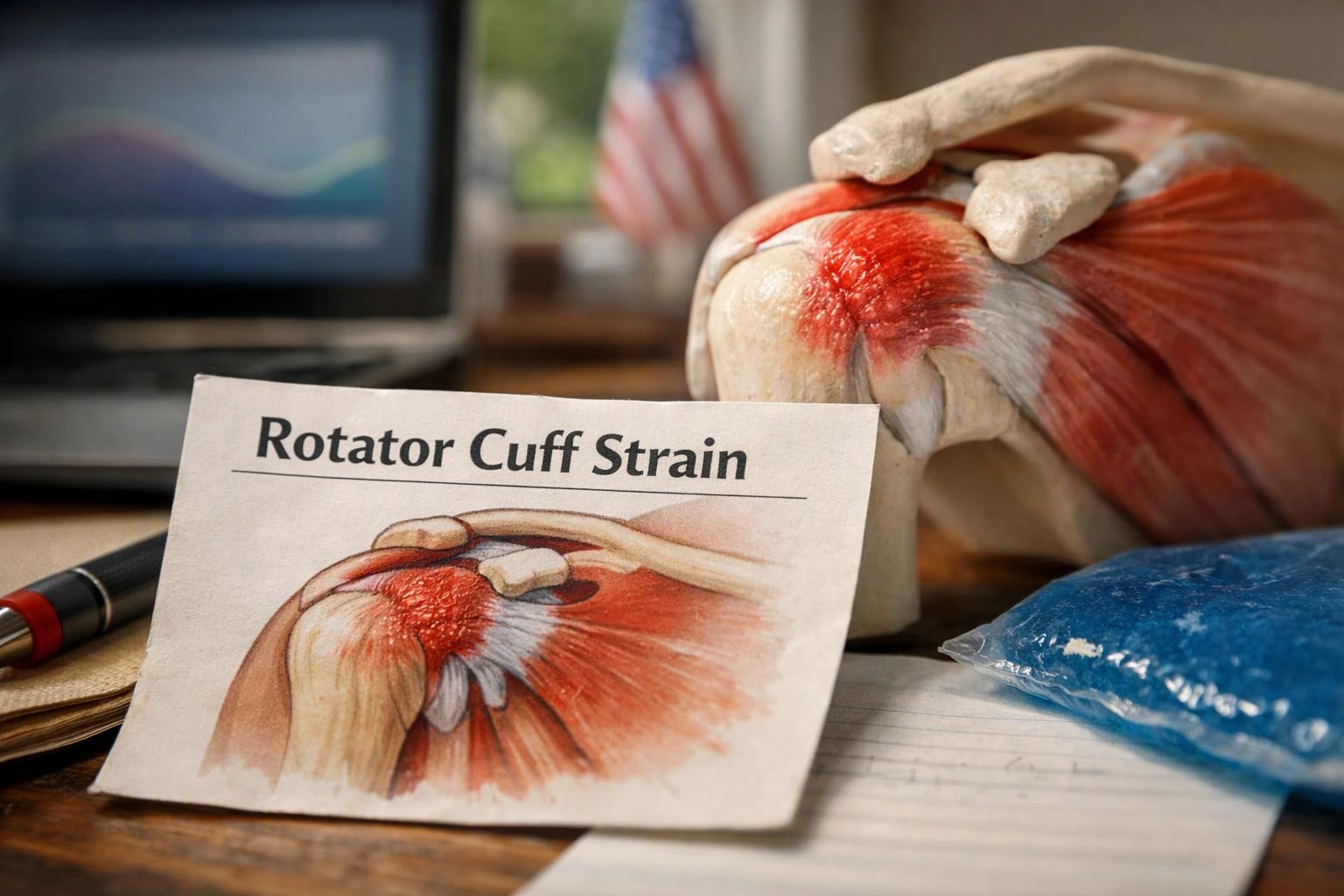
Rotator Cuff Strain develops when shoulder-supporting tissue is exposed to force or repeated motion that exceeds its current tolerance. The rotator cuff helps guide the upper arm within the shoulder joint, so irritation may affect lifting, reaching, pushing, or pulling. Symptoms often change with the position of the arm and the amount of load involved.
Related glossary terms: Soft Tissue Injury, Range of Motion, Referred Pain.
Assessment connects the reported activity with shoulder movement, strength, tenderness, and functional limits. A practitioner may compare movement on both sides and check nearby regions, including the thoracic spine and shoulder blade mechanics. The findings help distinguish a strain from related problems such as referred pain, joint restriction, or a more serious tissue injury.

From the Arrowhead Clinic Chiropractor Hinesville team
When we assess a suspected rotator cuff strain, we review how the symptoms began and which movements reproduce them. We check shoulder motion, strength, and nearby joint mechanics before selecting care within our Sports Injury Treatment service. We also watch for findings that may require evaluation beyond routine musculoskeletal care.
Rotator Cuff Strain in Practice: A Real-World Example
A recreational softball player develops shoulder pain after repeated throwing during practice. The discomfort increases when the player reaches overhead, and an assessment focuses on shoulder motion, strength, and the mechanics of the upper back and shoulder blade.
Related Services
Related Terms
Soft Tissue Injury
Soft Tissue Injury is a damage pattern affecting muscles, tendons, ligaments, fascia, or other connective tissue…
Range of Motion
Range of Motion is the available movement at a joint, measured through a specific direction or…
Referred Pain
Referred Pain is a pain signal felt in an area away from its source. The source…
Thoracic Spine
Thoracic Spine is the middle section of the vertebral column, located between the cervical spine in…
Arrowhead Clinic Chiropractor Hinesville
Have Questions About Rotator Cuff Strain?
Contact Arrowhead Clinic Chiropractor Hinesville for practical guidance on Rotator Cuff Strain and related chiropractor work in Hinesville.