Before Spinal Decompression: Symptoms and Questions to Review
Spinal decompression therapy checklists help you review symptoms, health conditions, treatment goals, red flags, and questions before care; Arrowhead Clinic Chiropractor Hinesville uses this information to guide the evaluation.
Request an EstimateWhat to Review Before Spinal Decompression Therapy
Spinal decompression therapy is a form of conservative spine care that uses guided treatment to address some back or neck conditions. Before care, we review your symptoms, health history, and treatment goals to decide whether the approach fits your needs.
Back pain, neck pain, and disc-related symptoms can appear in different patterns. Pain may stay near the spine or become radiating pain that travels into an arm or leg. Our team uses your symptom history and clinical findings to shape the evaluation.
Your Before-Treatment Spinal Decompression Checklist
Before spinal decompression, prepare information that helps us understand the source and pattern of your symptoms. Clear details about your medical history and prior care help our team assess treatment suitability.
This information does not determine candidacy by itself. We combine your answers with a physical examination and other clinical findings before discussing a treatment plan.
Who May Be a Candidate for Spinal Decompression?
Spinal decompression may be considered when symptoms and examination findings suggest a condition that could respond to the therapy, but Arrowhead Clinic Chiropractor Hinesville determines candidacy through an individual evaluation.
A candidate for spinal decompression may have a herniated disc, sciatica, radiating pain, or other disc-related symptoms. A disc bulge, disc degeneration, or nerve irritation may also be relevant when the findings match the symptom pattern.
Our clinical evaluation considers the location of pain, numbness or tingling, muscle weakness, range of motion, and neurological symptoms. We use these findings to decide whether spinal decompression, another form of care, or further medical assessment is appropriate.
Red Flags to Report Before Treatment
Spinal decompression should not be the first step when symptoms suggest a potentially serious condition that requires urgent medical evaluation.
Tell our team about urgent symptoms before discussing treatment. Seek urgent medical evaluation when these warning signs are present.
We use these red flags to help determine whether urgent medical evaluation is needed before conservative spine care.
What to Expect During the Evaluation
A physical examination reviews your movement, pain response, strength, and signs that may relate to the spine or nerves. We begin by discussing your symptoms and health history.
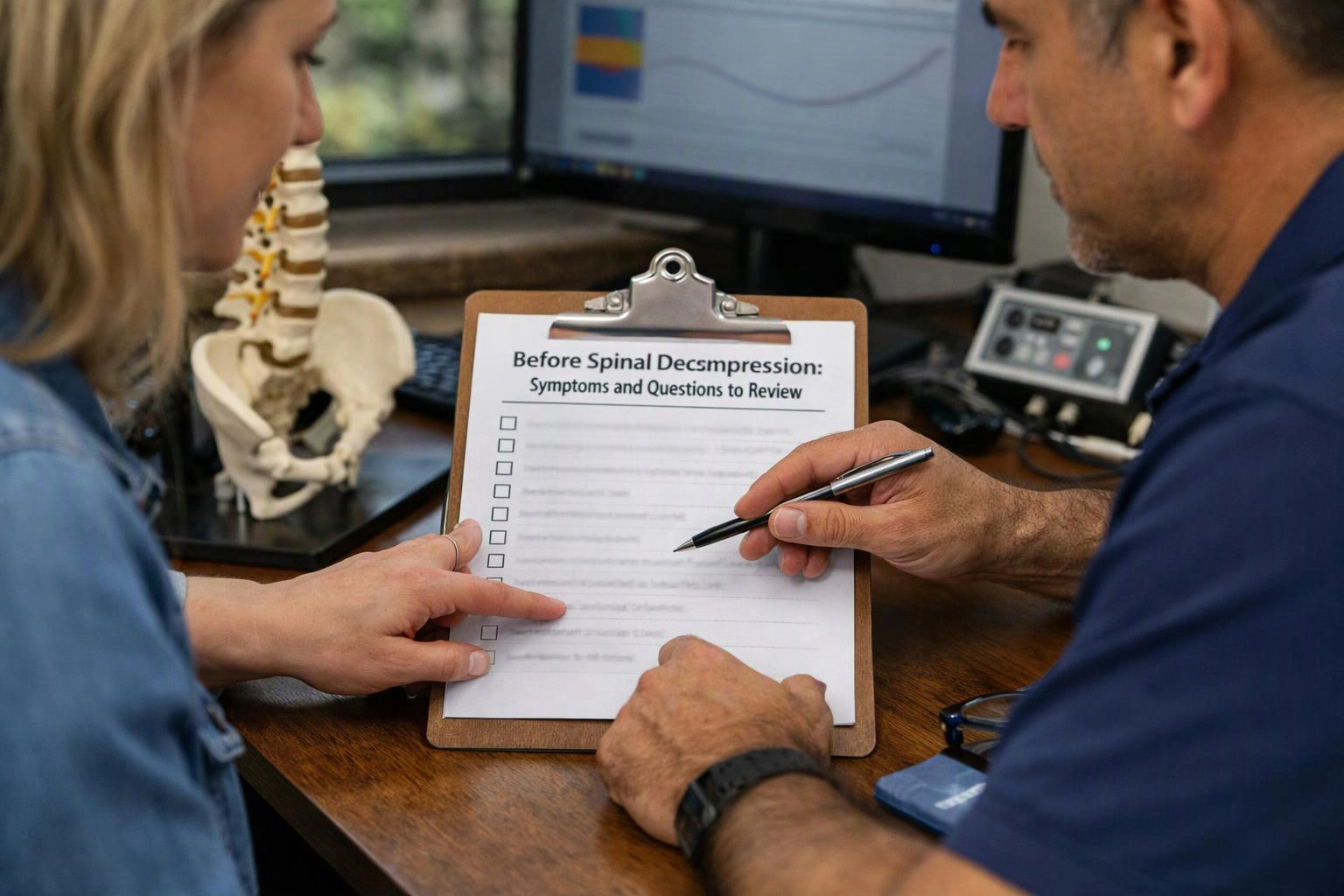
Our team may assess range of motion, posture, tenderness, and neurological symptoms such as numbness, tingling, or weakness. A pain assessment helps us understand what activities affect your symptoms.
We use the examination findings to discuss treatment suitability. If spinal decompression does not match the findings, we explain the next appropriate step for your care.
Questions to Ask About Your Spinal Decompression Plan
Questions before treatment help you understand why spinal decompression is being considered and how progress will be reviewed. Bring these questions to your evaluation so our team can address them with your findings in mind.
Our team answers these questions using your clinical evaluation rather than applying a one-size-fits-all plan.
Health Conditions and Medications to Disclose
Health conditions, recent procedures, injuries, medications, and pregnancy status should be disclosed because they may affect whether spinal decompression is appropriate.
Tell us about osteoporosis, spinal instability, recent surgery, fracture, infection, cancer history, pregnancy, and blood-thinning medication. Include relevant prior surgery and any change in your health since earlier treatment.
This information helps our team identify safety considerations and decide whether more evaluation is needed. Bring an updated medication list and explain any recent diagnosis or procedure clearly.
Your After-Visit Checklist
After the evaluation, use the instructions from our team to track symptoms and understand the next care decision. Your notes can help us compare your response with the original treatment goals.
Contact our team if symptoms worsen or if new neurological symptoms appear. Worsening symptoms may require prompt reassessment.
How Arrowhead Clinic Chiropractor Hinesville Uses Your Checklist
Arrowhead Clinic Chiropractor Hinesville uses your checklist during the clinical intake to connect symptom patterns, health history, and treatment goals with the physical examination. We use this information when considering spinal decompression therapy, herniated disc treatment, or sciatica treatment.
Our team reviews prior imaging, medications, previous treatment, and red flags before treatment planning. This process helps us discuss whether conservative spine care matches your needs and what progress monitoring may involve.
We provide Free Consultations so you can discuss your symptoms and questions before making care decisions. Bring your checklist so the evaluation focuses on the concerns that matter most to you.
Questions About Preparing for Spinal Decompression
What symptoms should I mention before spinal decompression therapy?
Arrowhead Clinic Chiropractor Hinesville needs to know about pain location, radiating pain, numbness or tingling, muscle weakness, symptom triggers, and changes over time. These details help us connect your symptoms with the examination.
What medical conditions can affect spinal decompression treatment?
Osteoporosis, spinal instability, recent surgery, fracture, infection, cancer history, pregnancy, and blood-thinning medication can affect treatment decisions. Disclose these conditions so we can assess safety and treatment suitability.
Can sciatica make someone a candidate for spinal decompression?
Yes, sciatica may be considered when the symptom pattern and examination findings suggest a condition that could respond to spinal decompression. Candidacy depends on an individual clinical evaluation.
Should I bring imaging results to a spinal decompression evaluation?
Yes, bring available imaging results because prior images may add context to your symptom history and examination. Our team considers imaging with your current findings rather than using it alone to choose care.
What should I do if symptoms worsen after spinal decompression?
Contact our team if symptoms worsen after spinal decompression, especially if new weakness, numbness, or bowel or bladder changes occur. Urgent symptoms require urgent medical evaluation.
Arrowhead Clinic Chiropractor Hinesville can review your symptoms, health history, and treatment questions during a Free Consultation. Bring your checklist so we can discuss the safest next step for your care.